Animals
Whales evolved from land mammals; Pakicetus walked on four legs about 50 million years ago
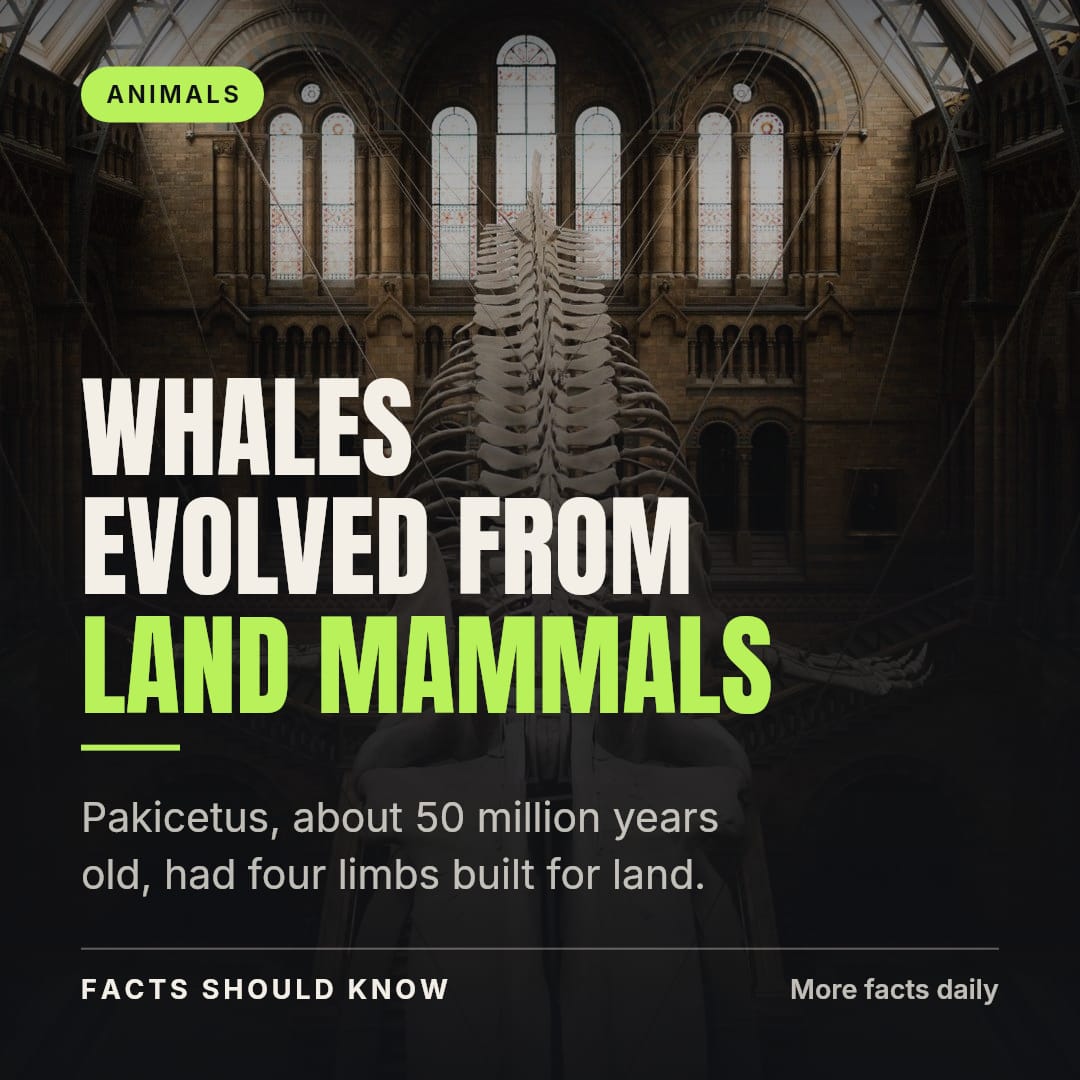
Pakicetus lived about 50 million years ago, in what is now Pakistan. It had four limbs suited to life on land. Yet one bone in its ear carries a feature otherwise known only in whales.
A land animal from Pakistan
Pakicetus fossils come from early Eocene rocks in Pakistan. The rocks are dated to roughly 50 million years ago, and the age is approximate. Philip Gingerich and colleagues described the animal in the early 1980s.
Early reconstructions showed Pakicetus as an otter-like swimmer. Later skeletons changed that picture. It was a land-dwelling animal that likely waded near fresh water, and it was not a strong swimmer.
The ear that links it to whales
The ear region of Pakicetus has a thickened inner bony wall called the involucrum. Outside this animal, the feature is known only in cetaceans, the group that includes whales. That is what ties Pakicetus to them.
The link should stay narrow. Its hearing was probably adapted for air rather than for underwater use. The shared feature is the involucrum, not ears like those of modern whales.
Legs, ankles and a hoofed relative
A 2001 paper in Nature, by Thewissen and colleagues, described skeletons of Pakicetus and a second early cetacean, Ichthyolestes. Their limbs were adapted for walking on land. They were not flippers.
The same study looked at the ankle bone, the astragalus. It has a double-pulley shape characteristic of artiodactyls, the even-toed hoofed mammals. That supports a close relationship between whales and artiodactyls.
A 2007 study in Nature added another piece. It examined Indohyus, a small raoellid artiodactyl from India, and identified raoellids as the closest known relatives of cetaceans. This supports whales originating from land-dwelling artiodactyl ancestors.
What Pakicetus does and does not show
Pakicetus is a stem cetacean, an early branch of the group. It is not necessarily a direct ancestor of later whales. What it documents is an early, land-based stage of the transition from land mammals to fully aquatic ones.
The place of whales within the artiodactyls is well supported. The details of the exact ancestral lineage are still being studied.
Whales descend from four-legged land mammals related to even-toed hoofed mammals, and Pakicetus, an early cetacean with land-adapted limbs, shows that early stage. It is an early branch, not necessarily a direct ancestor.